 Yes? No? YES! I feel like we're about to enter a whole new world.
Tuesday, May 24, 2005
In case you haven't guessed...
I'm attempting to get a system in place where I can add photos to my largely ignored site at my leisure. Hopefully you should now be viewing a REAL BIG FISH! Yes? No? YES! I feel like we're about to enter a whole new world.
Yes? No? YES! I feel like we're about to enter a whole new world.


Thursday, May 19, 2005
Many roads up the same mountain
There are those Christians which are not comfortable with some aspects of the Bible. They're not fond of taking the Bible literally for it causes them great consternation. Maybe, on some levels, I'm even prone to agree but at the end of the day I must accept what the Bible says because I believe it to be the authoritative word of God.
One of the most important disagreements comes with those Christians who believe that there are other methods, other religions, other roads that eventually lead to God. Despite what Jesus might have said about being "the way, the truth, and the life", and no coming to the Father except through Him bit, they are not convinced. You see they can ignore scripture because they know the true nature of God, and He just didn't mean it to be so exclusive. Because He loves us, all of us, ya know. Well, I think he did mean to be a little exclusive. I'm willing to listen to those who think that the Jews are still ok because God made a covenant with them that has yet to be completed, but that is where the listening ends. I mean, I won't be rude about it or anything, but the language is pretty clear and with it coming from the Bible which happens to be quoting the Savior of the world and all, I'm pretty comfortable in my literal interpretation.
I think Paul might agree with me (I Cor. 15:17), but I know some don't. Some will say that would make Christianity intolerant. Obviously, I would disagree. Anyone who read the Bible or at least the Jesus parts will quickly find him extremely tolerant of all. Let's see...my Lord is tolerant. Also, I'm told to emulate my Lord. Ergo...? I'm not saying we Christians pull this off, I'm just saying the blueprint of our religion would hopefully lead us there. I have met very few Christians in favor of theocracy where we could then enforce our intolerance, but maybe I'm just running in the wrong circles.
But just in case anyone thinks Christians have cornered the market on exclusivity or even intolerance, let me introduce you to a true example of intolerance bordering on hate. (HT: Lileks)
Who doesn't feel warm and fuzzy after that? I know there are those that will be quick to cry that he does not represent the Muslim religion...and they're probably right. Except, how much dancing in the streets do we have to see when the towers fell? Why do nations that consider themselves Muslim view religious freedom as such a foreign concept? Exactly how many times do I have to be called an infidel? How can so many be perfectly comfortable with the hating of and entire nation, if not hemisphere, in regards to the tenets of their religion.
All that to say, these two religions are not leading to the same peak, and one of them definitely doesn’t think so.
What's that? Need a Deadwood quote? What are my words not enough for you!? Fine:
One of the most important disagreements comes with those Christians who believe that there are other methods, other religions, other roads that eventually lead to God. Despite what Jesus might have said about being "the way, the truth, and the life", and no coming to the Father except through Him bit, they are not convinced. You see they can ignore scripture because they know the true nature of God, and He just didn't mean it to be so exclusive. Because He loves us, all of us, ya know. Well, I think he did mean to be a little exclusive. I'm willing to listen to those who think that the Jews are still ok because God made a covenant with them that has yet to be completed, but that is where the listening ends. I mean, I won't be rude about it or anything, but the language is pretty clear and with it coming from the Bible which happens to be quoting the Savior of the world and all, I'm pretty comfortable in my literal interpretation.
I think Paul might agree with me (I Cor. 15:17), but I know some don't. Some will say that would make Christianity intolerant. Obviously, I would disagree. Anyone who read the Bible or at least the Jesus parts will quickly find him extremely tolerant of all. Let's see...my Lord is tolerant. Also, I'm told to emulate my Lord. Ergo...? I'm not saying we Christians pull this off, I'm just saying the blueprint of our religion would hopefully lead us there. I have met very few Christians in favor of theocracy where we could then enforce our intolerance, but maybe I'm just running in the wrong circles.
But just in case anyone thinks Christians have cornered the market on exclusivity or even intolerance, let me introduce you to a true example of intolerance bordering on hate. (HT: Lileks)
The day will come when we will rule America. The day will come when we will rule Britain and the entire world – except for the Jews. The Jews will not enjoy a life of tranquility under our rule, because they are treacherous by nature, as they have been throughout history. The day will come when everything will be relived of the Jews - even the stones and trees which were harmed by them. Listen to the Prophet Muhammad, who tells you about the evil end that awaits Jews. The stones and trees will want the Muslims to finish off every Jew.
- Courtesy Sheik Ibrahim Mudeiris
Who doesn't feel warm and fuzzy after that? I know there are those that will be quick to cry that he does not represent the Muslim religion...and they're probably right. Except, how much dancing in the streets do we have to see when the towers fell? Why do nations that consider themselves Muslim view religious freedom as such a foreign concept? Exactly how many times do I have to be called an infidel? How can so many be perfectly comfortable with the hating of and entire nation, if not hemisphere, in regards to the tenets of their religion.
All that to say, these two religions are not leading to the same peak, and one of them definitely doesn’t think so.
What's that? Need a Deadwood quote? What are my words not enough for you!? Fine:
"Don't play that sh*t where you make me drag your words out. Declare, or shut the f*ck up"
Wednesday, May 18, 2005
Looking a Gift Horse in the ...?
Ok, as I write this, it is 11:30 am. I am now over 20 hours into my 40-hour workweek. I have yet to be assigned a new task...for the week. The average is about 3 a day. My tally for the week still sits at ZERO.
Positives? I have had to do very little work-- I've done some, just on stuff from last week. Fully caught up on blogs and newspaper. New minesweeper record (well, on this computer at least).
Negatives? Will someone (i.e. my boss, or worse yet, my boss' boss) realize, or at least contemplate, "We don't need this guy"? Getting bored. Possible carpal tunnel from minesweeper marathon.
Nonetheless, I will not worry. I will not glance at any part of the gift horse's anatomy.
Oh, why yes, you do get another quote from Deadwood:
Positives? I have had to do very little work-- I've done some, just on stuff from last week. Fully caught up on blogs and newspaper. New minesweeper record (well, on this computer at least).
Negatives? Will someone (i.e. my boss, or worse yet, my boss' boss) realize, or at least contemplate, "We don't need this guy"? Getting bored. Possible carpal tunnel from minesweeper marathon.
Nonetheless, I will not worry. I will not glance at any part of the gift horse's anatomy.
Oh, why yes, you do get another quote from Deadwood:
Jack McCall, on realizing he's drawn the ire of a notorious gunfighter: "Should we shake hands or something, relieve the atmosphere. I mean how stupid do you think I am?"
Wild Bill Hickok: "I don't know, I just met you."
Friday, May 13, 2005
Thursday, May 12, 2005
Why today doesn't suck
Today, Baseball hall-of-famer Yogi Berra turns 80 years old. 
And just in case you're curious. The famed cartoon, Yogi Bear, was named after him, not vice-versa. In celebration of Yogi, and his great career, some of his malapropisms:
God bless Yogi Berra.
Now, the next episode in our continuing saga of Deadwood quotes:
Berra, Yogi (Lawrence Peter Berra) , 1925–, American baseball player and manager, b. St. Louis. An outstanding catcher with the New York Yankees (1946–63), Berra was the American League's Most Valuable Player in 1951, 1954, and 1955, hit 358 career home runs and appeared in 14 World Series. He managed the Yankees and Mets for a total of seven years, leading each team to the pennant (Yankees, 1964; Mets, 1973); he also coached with the Mets, Yankees, and Astros, Berra is renowned for his unintendedly ironic humorous comments.
And just in case you're curious. The famed cartoon, Yogi Bear, was named after him, not vice-versa. In celebration of Yogi, and his great career, some of his malapropisms:
When you get to a fork in the road, take it.
Nobody goes there anymore because it's too crowded.
At a dinner in an Italian restaurant, he was asked how many slices should be cut in his pizza, and he replied "You better make it four, 'cause I don't think I could eat six."
And of course,"It's like déjà vu all over again."
God bless Yogi Berra.
Now, the next episode in our continuing saga of Deadwood quotes:
"The Creator in His infinite wisdom Mrs. Garret salted His works so where gold was, there also you'd find rumor."
Wednesday, May 11, 2005
Am I the only one?
Twelve years after the release and subsequent deluge of "Chattahoochee" by Alan Jackson, I'm still left wondering after that second line. What does hoochie-coochie mean? How hot is "hotter than a hoochie coochie?". I'm assuming that's really hot. But really, what is Alan talking about when he says hoochie-coochie? No really. No...REALLY.
And now for today's obligatory Deadwood quote:
And now for today's obligatory Deadwood quote:
"[D]on't you agree that truth, if only a pinch, must season every falsehood, or else the palate f**king rebels?"
Tuesday, May 10, 2005
The Knowing Nod
After a weekend at home being regaled by tales from my dearest mother and my sister regarding the attending of a baby shower and the ins and outs of female conversation and lack thereof, I was left much relieved that I was born of the masculine persuasion. I take great comfort in the fact that a complete discourse between two men can be replaced without loss of understanding or feeling by what Mike Rhyner has dubbed "the knowing nod".
Instead of verbalizing, "Thanks for the drink," a perfect substitute? Knowing nod.
Greeting at doorway of restaurant, office, mailbox? Anywhere really. Knowing nod.
You don't need a hand written thank-you note. What do you need? Knowing nod.
"That was very gentlemanly of you to let me out of the turn only lane." Knowing nod.
"Nice putt." Knowing nod.
"Glad you put that loud-mouthed drunk in his place." Knowing nod.
"What's the score?" Knowing nod. (In direction of TV set with said game)
As the AMC theater is always ready to note...
Silence Is Golden® (Yes, they claim to have it trademarked.)
And now our daily feature on quotes harvested from Deadwood concerning politics (or anything else I find interesting).
Instead of verbalizing, "Thanks for the drink," a perfect substitute? Knowing nod.
Greeting at doorway of restaurant, office, mailbox? Anywhere really. Knowing nod.
You don't need a hand written thank-you note. What do you need? Knowing nod.
"That was very gentlemanly of you to let me out of the turn only lane." Knowing nod.
"Nice putt." Knowing nod.
"Glad you put that loud-mouthed drunk in his place." Knowing nod.
"What's the score?" Knowing nod. (In direction of TV set with said game)
As the AMC theater is always ready to note...
Silence Is Golden® (Yes, they claim to have it trademarked.)
And now our daily feature on quotes harvested from Deadwood concerning politics (or anything else I find interesting).
"If we're going to be surprised by that, boys—government being government—will we next be shocked by the rivers running and the trees casting f---ing shade?"
Monday, May 09, 2005
Say what you will
Two quick quotes that made me chuckle. One from Hugh Hewitt's site:
That leads us to this one, from HBO's Deadwood, a show not safe for children nor most women, I suspect. Nonetheless, a character known for being the point man in an attempt of a wealthy businessman to basically con the entire town, being responsible for the death of many (including an odd penchant for slitting the necks of prostitutes with which he is finished), and being complicit in what is essentially sex-slave trade was quoted as saying:
Indeed.
A day after Senator Uriah Reid (D-Nev) brands the president a "loser" and then apologizes, a week after Senator Ken Salazar (D-Colo) labels Focus on the Family as the anti-Christ and then apologizes, and a month after Senator Robert Byrd (D-WVA) brands the Senate GOP as Hitler's heirs, Senator Charles Schumer (D-NY) appeals to President Bush to bring moderation to the Republican side of the debate on the filibusters. Now that is rich. Wildly amusing and ineffective, but rich.
Especially when you consider this account of Senator Reid's appearance before high school students yesterday:
"Reid took students through a primer of the five most-disputed judicial nominees, arguing some were opposed to the 1973 Roe v. Wade case legalizing abortion. He charged others with trying to dismantle government programs like Social Security.
'I don't want them. I think they're bad people,' Reid said of the nominees
He described California Supreme Court Justice Janice Rogers Brown, one of the Bush nominees Republicans will probably float first for approval, as an African-American opposed by the Congressional Black Caucus.
'She is a woman who wants to take us back to the Civil War days,' Reid said."
That leads us to this one, from HBO's Deadwood, a show not safe for children nor most women, I suspect. Nonetheless, a character known for being the point man in an attempt of a wealthy businessman to basically con the entire town, being responsible for the death of many (including an odd penchant for slitting the necks of prostitutes with which he is finished), and being complicit in what is essentially sex-slave trade was quoted as saying:
"I am a sinner who does not expect forgiveness. But I am not a government official. "
Indeed.
Friday, April 15, 2005
So now we know.
John McCain, Senator (D-AZ) made it known last night on which side of the aisle he stands. To him I say good riddance. Ever since he has exploded on the scene with his 2000 presidential run, I've been leery. Always struck me as a liberal in Republican's clothing. And just in case the debacle that is McCain-Fiengold wasn't enough, I'm now willing to firmly affix this one in the "Yes, I was right all along" column. Go ahead and let the Democrats run wild and use every underhanded tactic in the book; that's what democracy is all about, right?
Thursday, April 14, 2005
Delicious
First, I would feel remiss if I did not make some mention of the fact that...BASEBALL HAS RETURNED! Thank God. My security blanket is back. I attended the Ranger's home opener on Monday making it official. Hot dogs were consumed. Cotton candy became epoxy on the face of accompanying youngster. A spirited cry of “CHARGE!” exited my lips. Also, the Rangers lost said opener and my fantasy team is in 8th place, this rubber-stamping the official notification. So I say,"Hello baseball!"
Next, In the past I have noted bathroom oddities (Yes, he's still around...and yes, I still hear the song) but some recent events compel me to share. I’m starting to wonder if I the weird one. First, (less odd of the two) a guy using the stall, and I mean "USING THE STALL", chose not to lock the door. Was the lock broken? No. Just couldn't be troubled, I guess. Also, he didn't seem bothered at all when a Director walked in on him. The director in question was bothered, or at minimum shocked, by pushing open an unlocked stall door and finding it occupied, but he had no reaction to the event. Then a couple days later, as I "stand at the wall" I hear a digitized female voice behind me (that's where the stalls are). I realize that someone who is "using the stall" is also involved in a phone conversation! With a woman! Now, I'm no longer shocked running across the "stall sleeper" or the guy using the time to update his Blackberry or play games on a cell phone, but actually taking a call? But I must ask, "I'm the only one bothered by such behavior?"
Finally, can we go ahead and tag you as "bitter elitist" if after losing an election for the highest political office in the land you blame it on the fact that, "Leaflets are handed out saying Democrats vote on Wednesday, Republicans vote on Tuesday. People are told in telephone calls that if you've ever had a parking ticket, you're not allowed to vote." Huh? Yep, he said it. John F. Kerry thinks people are so dumb, that is, he thinks the people who were going to vote for him are so dumb that they thought the election was on Wednesday. Or that a traffic ticket deemed them ineligible to vote. Obviously, it doesn't, but I willing to say believing such things should. If you have to ask the question, "Can I still vote if I got caught for doing 42 in a 35?” the answer is, "No. May I have your ballot please?" End of story. Kerry voters...the Wednesday majority.
Next, In the past I have noted bathroom oddities (Yes, he's still around...and yes, I still hear the song) but some recent events compel me to share. I’m starting to wonder if I the weird one. First, (less odd of the two) a guy using the stall, and I mean "USING THE STALL", chose not to lock the door. Was the lock broken? No. Just couldn't be troubled, I guess. Also, he didn't seem bothered at all when a Director walked in on him. The director in question was bothered, or at minimum shocked, by pushing open an unlocked stall door and finding it occupied, but he had no reaction to the event. Then a couple days later, as I "stand at the wall" I hear a digitized female voice behind me (that's where the stalls are). I realize that someone who is "using the stall" is also involved in a phone conversation! With a woman! Now, I'm no longer shocked running across the "stall sleeper" or the guy using the time to update his Blackberry or play games on a cell phone, but actually taking a call? But I must ask, "I'm the only one bothered by such behavior?"
Finally, can we go ahead and tag you as "bitter elitist" if after losing an election for the highest political office in the land you blame it on the fact that, "Leaflets are handed out saying Democrats vote on Wednesday, Republicans vote on Tuesday. People are told in telephone calls that if you've ever had a parking ticket, you're not allowed to vote." Huh? Yep, he said it. John F. Kerry thinks people are so dumb, that is, he thinks the people who were going to vote for him are so dumb that they thought the election was on Wednesday. Or that a traffic ticket deemed them ineligible to vote. Obviously, it doesn't, but I willing to say believing such things should. If you have to ask the question, "Can I still vote if I got caught for doing 42 in a 35?” the answer is, "No. May I have your ballot please?" End of story. Kerry voters...the Wednesday majority.
Tuesday, April 05, 2005
Breaking News...Apple Still Sucks
So, for Christmas I acquired an MP3 player. One with a 30 gig capacity. With it I now have the capability to carry around my entire music collection (approx. 650 CD's) in something that will fit into my pocket. I quite like it. It's nice to be able to go from home to car to work to car to home and be able to listen to any song I have. Plus I can use the CD holder in the console of my car to hold potpourri.
One major distinction, though. I did not buy an iPod. Not that I was inherently anti-iPod. I think they're quite stylish and functional...you know, nifty. What I could not get my head around is why I should pay 40% more for 33% less capacity while losing little, if any, functionality. Some have even said that the sound quality of the one I purchased is better than that of the venerable iPod. I might even be talked into the fact that the iPod is a somewhat superior product, but not by a wide margin. Even if it is, the facts remaining true, I have to wonder why anyone would buy an iPod today. This is not so for those have been carrying one around for a couple of years. Back then, this was a cutting edge product whose competitors were priced similarly. Why not go with the iPod? But now? Now doesn't it just come down to the "cult of cool"? Is this not just the Members Only jacket and parachute pant for the Oughts' techno literate/music lover?
I guess it's just not cool to get value. But how else do you explain that iPods are still out selling all comers when I was able to get a 30 gig jukebox, a smaller, 128mb player for jogging and such (with an FM tuner and recorder. Take that Shuffle!) and an FM Transmitter for less than the cost of said 20 gig iPod? But all of this is not even my point. "If you want to be gay and deaf and go have deaf babies, have at it."
Despite the fact I believe iPods are currently a rip-off, I do not deny that Apple has made a good product. A product people like. One that I'm sure I could enjoy if given one. This had me softening on my stance that Apple wasn't all that bad. Every once and while they could get off their high-horse and make something which all us hoi polloi could enjoy. Along with the iPod came iTunes. In the wake of the death of Napster, it was also quite popular. Selling digital songs for 99 cents. What's so bad about that? Nothing I would say. I've had the iTunes software downloaded for quite some time, and found it quite functional as well. After downloading the software comes the obligatory avalanche of email. iTunes features a free (FREE? I love FREE!) download each week. The events of me actually reading the email and seeing a song that might interest me finally collided. I dutifully opened up iTunes and after having to set up an account; I downloaded my first track from iTunes. How easy was that!? Don't we all love Apple?
Skip ahead a couple of days. Time to add said (FREE!) track to my juke for listening at my leisure. I go into the software that accompanied the player (because iTunes only recognizes iPods, of course) and can't find the song. There's the directory. There's the folder. No song. Huh. Go back to Explorer (Alert! I'm working in a Windows environment here) and there's the song. OK...? What format is this in? Oh, AAC (A.K.A. M4p)? I bet I need to just set my software to recognize that format. Not there. Dangit. Ok, I just need to change the format of the file to Mp3. iTunes gives me the option. I take it. STOP! "iTunes cannot complete task because Apple sucks and wants you to assimilate... I mean... the file is protected." Yes, of course. Any song you download from iTunes is in a protected AAC format. One that iTunes cannot reformat. Genius. Of course. If you've got this great software and this huge catalogue of songs you would obviously want to set it up where only people who purchase your over-priced product can use it.
I can still do this. I will not give up. I am not a quitter. I know! Google will rescue me. Search for "Format ACC to Mp3" and I bet it will take me to some freeware that will fix me right up. (Slumps at keyboard)...Or not. It just takes me to dozens of other sites where guys are having the same problem as me. With it I find that I am left with 3 options. (1) Download this very odd software that runs in DOS mode and takes (reportedly) 2-3 times longer than ripping a song off a CD to reformat the files. DOS and long delays, sign me up! (2) Burn songs from iTunes onto a CD and then rip them back in Mp3 format. That seems efficient. Why don't I just listen to the song and then hum it into a microphone attached to my computer? (3) Devoid my computer and mind of ever using iTunes (and most likely any other Apple product) again. Guess which way I'm leaning.
This all brings up one other question. Why is Microsoft, which I'm honestly not a huge fan of, always demonized for being a "monopoly" when Apple builds machines that use a singular operating system that only they produce? Then they create a music service that sells music, but only in a format that the machines they produce will recognize. How are Apple's practices less anti-competition than Microsoft's? And besides, Apple sucks.
One major distinction, though. I did not buy an iPod. Not that I was inherently anti-iPod. I think they're quite stylish and functional...you know, nifty. What I could not get my head around is why I should pay 40% more for 33% less capacity while losing little, if any, functionality. Some have even said that the sound quality of the one I purchased is better than that of the venerable iPod. I might even be talked into the fact that the iPod is a somewhat superior product, but not by a wide margin. Even if it is, the facts remaining true, I have to wonder why anyone would buy an iPod today. This is not so for those have been carrying one around for a couple of years. Back then, this was a cutting edge product whose competitors were priced similarly. Why not go with the iPod? But now? Now doesn't it just come down to the "cult of cool"? Is this not just the Members Only jacket and parachute pant for the Oughts' techno literate/music lover?
I guess it's just not cool to get value. But how else do you explain that iPods are still out selling all comers when I was able to get a 30 gig jukebox, a smaller, 128mb player for jogging and such (with an FM tuner and recorder. Take that Shuffle!) and an FM Transmitter for less than the cost of said 20 gig iPod? But all of this is not even my point. "If you want to be gay and deaf and go have deaf babies, have at it."
Despite the fact I believe iPods are currently a rip-off, I do not deny that Apple has made a good product. A product people like. One that I'm sure I could enjoy if given one. This had me softening on my stance that Apple wasn't all that bad. Every once and while they could get off their high-horse and make something which all us hoi polloi could enjoy. Along with the iPod came iTunes. In the wake of the death of Napster, it was also quite popular. Selling digital songs for 99 cents. What's so bad about that? Nothing I would say. I've had the iTunes software downloaded for quite some time, and found it quite functional as well. After downloading the software comes the obligatory avalanche of email. iTunes features a free (FREE? I love FREE!) download each week. The events of me actually reading the email and seeing a song that might interest me finally collided. I dutifully opened up iTunes and after having to set up an account; I downloaded my first track from iTunes. How easy was that!? Don't we all love Apple?
Skip ahead a couple of days. Time to add said (FREE!) track to my juke for listening at my leisure. I go into the software that accompanied the player (because iTunes only recognizes iPods, of course) and can't find the song. There's the directory. There's the folder. No song. Huh. Go back to Explorer (Alert! I'm working in a Windows environment here) and there's the song. OK...? What format is this in? Oh, AAC (A.K.A. M4p)? I bet I need to just set my software to recognize that format. Not there. Dangit. Ok, I just need to change the format of the file to Mp3. iTunes gives me the option. I take it. STOP! "iTunes cannot complete task because Apple sucks and wants you to assimilate... I mean... the file is protected." Yes, of course. Any song you download from iTunes is in a protected AAC format. One that iTunes cannot reformat. Genius. Of course. If you've got this great software and this huge catalogue of songs you would obviously want to set it up where only people who purchase your over-priced product can use it.
I can still do this. I will not give up. I am not a quitter. I know! Google will rescue me. Search for "Format ACC to Mp3" and I bet it will take me to some freeware that will fix me right up. (Slumps at keyboard)...Or not. It just takes me to dozens of other sites where guys are having the same problem as me. With it I find that I am left with 3 options. (1) Download this very odd software that runs in DOS mode and takes (reportedly) 2-3 times longer than ripping a song off a CD to reformat the files. DOS and long delays, sign me up! (2) Burn songs from iTunes onto a CD and then rip them back in Mp3 format. That seems efficient. Why don't I just listen to the song and then hum it into a microphone attached to my computer? (3) Devoid my computer and mind of ever using iTunes (and most likely any other Apple product) again. Guess which way I'm leaning.
This all brings up one other question. Why is Microsoft, which I'm honestly not a huge fan of, always demonized for being a "monopoly" when Apple builds machines that use a singular operating system that only they produce? Then they create a music service that sells music, but only in a format that the machines they produce will recognize. How are Apple's practices less anti-competition than Microsoft's? And besides, Apple sucks.
Monday, April 04, 2005
The Land of Shifty Canucks
In breaking news you probably won't find anywhere in the mainstream media, Canada's not real big on freedom of the press. Quick rundown, Canada's Liberal party is finding out that containing the details of a gigantic scandal is rather tricky business. It would seem that they've been funneling money to select advertising companies, and said companies do little or no work for their share of approximately $250 million before they kick-back about half of that to the Liberal party for campaign purposes. The obligatory ties to the mob or other organized crime are also involved. In addition, the threat of snap elections to offset any political fall-out was rumored. Fun stuff.
To investigate said activities, the Gomery Commission was created. Almost all testimony heard by the Commission has been made public, but then it was decided to enact a publication ban on the testimony of three pivotal witnesses: Jean Brault, president of the ad agency Groupaction, Charles Guité, an officer of the Public Works ministry who worked on the Sponsorship Program, and Paul Coffin, president of the ad agency Coffin Communications. After the contents of the testimony of Jean Brault was reported by this blog, their attempt at keep a lid on the scandal resulted in threats that any Canadian publication that reported on barred testimony or any website linking to above blog could be held in contempt of court. To clue you in on the imagination of those involved, this quote from Inquiry official Francois Perreault: "We never thought someone would violate the publication ban," Perreault said. "Maybe we were more confident than we should have been." Never thought that someone would find out the details of explosive testimony and then publish it? If you say so. For a rundown of the events, go here(start at the bottom and go up).
To investigate said activities, the Gomery Commission was created. Almost all testimony heard by the Commission has been made public, but then it was decided to enact a publication ban on the testimony of three pivotal witnesses: Jean Brault, president of the ad agency Groupaction, Charles Guité, an officer of the Public Works ministry who worked on the Sponsorship Program, and Paul Coffin, president of the ad agency Coffin Communications. After the contents of the testimony of Jean Brault was reported by this blog, their attempt at keep a lid on the scandal resulted in threats that any Canadian publication that reported on barred testimony or any website linking to above blog could be held in contempt of court. To clue you in on the imagination of those involved, this quote from Inquiry official Francois Perreault: "We never thought someone would violate the publication ban," Perreault said. "Maybe we were more confident than we should have been." Never thought that someone would find out the details of explosive testimony and then publish it? If you say so. For a rundown of the events, go here(start at the bottom and go up).
Thursday, March 31, 2005
Sorry for the delay...
I've been spending some time trying to clean up the site. The single post pages now look much cleaner, so you may now link to your hearts desire and not be embarrassed about sending someone to such a mess (Like anyone ever links to my crummy blog in the first place.)
I will attempt to finish up with Jim Wallis and his various issues, or my various issues with him, today. It now gives me extreme tired head, but I still think it's important as this guy rises in prominence. So, I will try to end this series with some quick hitty things I've run across in interviews or articles on Jim's site (Sojourners). Some were not written by him, but since Wallis is the Editor-in-Chief/Executive Director of said organization, I think it's safe to say they met with his approval.
It's clear that Wallis and I disagree almost completely on the role of government. I also disagree with him on what a proposed "man of God's" priorities should be as it relates to politics and the individual. Another issue I have with Jim is his sometimes inflammatory and incendiary remarks that can devolve into name-calling. One example is in this Boston Globe review/interview. I think that if a Christian is trying to garner support for himself or a movement-- even if political-- he should not resort to unsubstantiated public accusations, especially towards other professed Christians, less they bring their own motives into question. But in said interview we get this exchange:
So, he "...tend[s] not to throw labels at people", but has no problem with the label of "fundamentalist" for Pat Robertson and Jerry Falwell? And is there any doubt that when he talks of Islamic fundamentalists he's alluding to terrorist? Ergo, Falwell is a terrorist? And let me just say that at least Falwell preaches and is pastor to an actual church. Maybe Jim just doesn’t "throw labels" at Presidents. That's probably smart, but also a little hypocritical. And while we are on the topic of hypocritical, the statement that fundy's "...want to take over and then legislate their religious agenda" strikes me as odd coming from Wallis. Isn't that exactly what he wants to do? Legislate feeding the poor and caring for the needy? You know when "we discover that faith challenges the powers that be to do justice for poor..."? Just checking. Oh, and also on that hypocrisy front, in 1984 Wallis endorsed Jesse Jackson for President (some might say I need no further arguments). His tax returns revealed that the year before he and his wife (I'm sure now estranged) earned about $115,000 and Jackson was able to part with a whole $500 of that for churches and charity. I would think one who thought that "caring for the least of these" is of the highest importance would find fault with such lack of charity. Oh...but...that's right, Jim doesn't care about that because he thinks that "...the particular religiosity of a candidate, or even how devout they might be, is less important than how their religious and/or moral commitments and values shape their political vision and their policy commitments." So now I can't decide if Jim is a hypocrite or not...I guess I'll let you decide.
Back to the name-calling. In this little ditty Mr. Wallis takes issue with Majority Leader Tom DeLay. Apparently he was disappointed by DeLay's lack of support for an amendment to a child tax credit that would have accelerated the refundability for families making between $10,500 and $26,650 (For the sake of brevity I will NOT point out that no family of four making $10,500 would pay income tax, but oh, sorry...). Also, it's not that they opposed the bill, just the acceleration (Damn Republicans!). So because of DeLay's despicable acts, Mr. Wallis states that Delay and his Republican colleagues "haven't been reading their Bibles the way..." others that support such measures have. But that pales in comparison to the next sentence when Wallis goes on to warn DeLay that he's on his way to becoming the "Bull" Connor of the anti-poverty movement. In case the name doesn't immediately register (didn't with me, either), "Bull" Connor is a swell guy who was a prominent city official in Birmingham, Alabama. Just so happens that during a month of peaceful demonstrations by Birmingham's African-American community against their city's segregation ordinances lead by none other than Martin Luther King, Jr., "Bull" tried to stop the growing demonstrations, and gained lasting infamy when he resorted to using water hoses and dogs. I can see why Jim Wallis received the "Religious Communicator of Faith" award. Can't you feel the love? One more note. The first time these tax cuts came around, this article on Sojourners declared it a "Victory!" for poor families. I quote,"[t]he Child Tax Credit in the new tax cut legislation allows families with earnings of more than $10,000 to receive a refund check even if they do not owe federal income taxes...While child advocates did not get everything we sought in a refundable tax credit for all children in need, the version passed is a major step forward that will help lift 500,000 children out of poverty." Yet, the next time around, even after checks had been cut to those who neither paid nor owed taxes, Wallis accuses opponents of an "acceleration" of having German Shepherds frothing and ready. I guess the ends justify the means when you looking out for the common good.
I could probably go on, but I hope I've supplied enough that you might share, at least, some of my leeriness of Jim Wallis. I wish it would have given him pause as well, but I'm sure he would assert that I "haven't been reading my Bible the way..." he would. On this, I'm sure he's right.
I will attempt to finish up with Jim Wallis and his various issues, or my various issues with him, today. It now gives me extreme tired head, but I still think it's important as this guy rises in prominence. So, I will try to end this series with some quick hitty things I've run across in interviews or articles on Jim's site (Sojourners). Some were not written by him, but since Wallis is the Editor-in-Chief/Executive Director of said organization, I think it's safe to say they met with his approval.
It's clear that Wallis and I disagree almost completely on the role of government. I also disagree with him on what a proposed "man of God's" priorities should be as it relates to politics and the individual. Another issue I have with Jim is his sometimes inflammatory and incendiary remarks that can devolve into name-calling. One example is in this Boston Globe review/interview. I think that if a Christian is trying to garner support for himself or a movement-- even if political-- he should not resort to unsubstantiated public accusations, especially towards other professed Christians, less they bring their own motives into question. But in said interview we get this exchange:
IDEAS: You're an evangelical but not a fundamentalist. Do you think most people understand the difference?
WALLIS: No, I think they don't, because the fundamentalists, like Jerry Falwell and Pat Robertson, have claimed the term evangelical as their own, and they want to say that they speak for all evangelicals. Now, anybody who's in the evangelical world knows that isn't true. . . . There's a new generation of young Christian activists, including evangelicals and Catholics both, who really don't fit into these old categories.
IDEAS: What makes Pat Robertson or Jerry Falwell a fundamentalist but not you?
WALLIS: Well, there's a whole history there. Fundamentalism exists not just in Christian faith, but in Islam and Judaism too. And often, there are a number of major mistakes they make. They go for power. They want to take over and then legislate their religious agenda. And they also are . . . attracted to the use of violence for their cause – whether it be terrorism on one hand or unilateral preemptive wars on the other. I would love to see fundamentalists pay more attention to Jesus. You know, how did Jesus become pro-rich, pro-war, and only pro-American?
IDEAS: Do you think that George W. Bush is a fundamentalist?
WALLIS: You know, I tend not to throw labels at people. . . . I don't quibble with his personal faith. He's a person I've talked to enough, in meetings and even in a couple of conversations that the two of us have had, that I think his faith is real. Where I disagree with George Bush is in his theology. I think that George Bush's God is a God of charity, and the Bible presents a God of justice, in terms of issues of poverty and economic justice. . . . I say budgets are moral documents. They reveal the priorities and values of a family, a church, a nation.
So, he "...tend[s] not to throw labels at people", but has no problem with the label of "fundamentalist" for Pat Robertson and Jerry Falwell? And is there any doubt that when he talks of Islamic fundamentalists he's alluding to terrorist? Ergo, Falwell is a terrorist? And let me just say that at least Falwell preaches and is pastor to an actual church. Maybe Jim just doesn’t "throw labels" at Presidents. That's probably smart, but also a little hypocritical. And while we are on the topic of hypocritical, the statement that fundy's "...want to take over and then legislate their religious agenda" strikes me as odd coming from Wallis. Isn't that exactly what he wants to do? Legislate feeding the poor and caring for the needy? You know when "we discover that faith challenges the powers that be to do justice for poor..."? Just checking. Oh, and also on that hypocrisy front, in 1984 Wallis endorsed Jesse Jackson for President (some might say I need no further arguments). His tax returns revealed that the year before he and his wife (I'm sure now estranged) earned about $115,000 and Jackson was able to part with a whole $500 of that for churches and charity. I would think one who thought that "caring for the least of these" is of the highest importance would find fault with such lack of charity. Oh...but...that's right, Jim doesn't care about that because he thinks that "...the particular religiosity of a candidate, or even how devout they might be, is less important than how their religious and/or moral commitments and values shape their political vision and their policy commitments." So now I can't decide if Jim is a hypocrite or not...I guess I'll let you decide.
Back to the name-calling. In this little ditty Mr. Wallis takes issue with Majority Leader Tom DeLay. Apparently he was disappointed by DeLay's lack of support for an amendment to a child tax credit that would have accelerated the refundability for families making between $10,500 and $26,650 (For the sake of brevity I will NOT point out that no family of four making $10,500 would pay income tax, but oh, sorry...). Also, it's not that they opposed the bill, just the acceleration (Damn Republicans!). So because of DeLay's despicable acts, Mr. Wallis states that Delay and his Republican colleagues "haven't been reading their Bibles the way..." others that support such measures have. But that pales in comparison to the next sentence when Wallis goes on to warn DeLay that he's on his way to becoming the "Bull" Connor of the anti-poverty movement. In case the name doesn't immediately register (didn't with me, either), "Bull" Connor is a swell guy who was a prominent city official in Birmingham, Alabama. Just so happens that during a month of peaceful demonstrations by Birmingham's African-American community against their city's segregation ordinances lead by none other than Martin Luther King, Jr., "Bull" tried to stop the growing demonstrations, and gained lasting infamy when he resorted to using water hoses and dogs. I can see why Jim Wallis received the "Religious Communicator of Faith" award. Can't you feel the love? One more note. The first time these tax cuts came around, this article on Sojourners declared it a "Victory!" for poor families. I quote,"[t]he Child Tax Credit in the new tax cut legislation allows families with earnings of more than $10,000 to receive a refund check even if they do not owe federal income taxes...While child advocates did not get everything we sought in a refundable tax credit for all children in need, the version passed is a major step forward that will help lift 500,000 children out of poverty." Yet, the next time around, even after checks had been cut to those who neither paid nor owed taxes, Wallis accuses opponents of an "acceleration" of having German Shepherds frothing and ready. I guess the ends justify the means when you looking out for the common good.
I could probably go on, but I hope I've supplied enough that you might share, at least, some of my leeriness of Jim Wallis. I wish it would have given him pause as well, but I'm sure he would assert that I "haven't been reading my Bible the way..." he would. On this, I'm sure he's right.
Wednesday, March 23, 2005
Hail Mary
One final attempt to give some (if not solid) backing why the government should intervene in protection of life. **NOTICE** I'm not talking about the Terri Shciavo case, but more to the abortion argument, not that I don't think it applies, though. A quick (hopefully) thought.
As I walked to my car after work I began thinking of The Declaration of Independence. I quickly realized that it contained exactly what I was attempting to express, but in one sentence instead of the 8 it took me to say it poorly. We hold these truths to be self-evident, that all men are created equal, that they are endowed by their Creator with certain unalienable Rights, that among these are Life, Liberty and the pursuit of Happiness. That's what I meant. Self-evident. And of those unalienable Rights, numero uno is Life. Capitalized no less. The defining document of our government thinks life is important, just like my God.
Also, a quick thought about Jim Wallis. I have stated in various ways that I find his priorities a little disconcerting. I will address other aspects of his "ministry" that bother me later, but as I perused another blog on my list of regulars I found this:
Then I think back to Wallis' quotes, "The values of politics are my primary concern," and "...the particular religiosity of a candidate, or even how devout they might be, is less important than how their religious and/or moral commitments and values shape their political vision and their policy commitments." It strikes me that this man of God is spending all is time on the mortal when Jesus clearly has his thoughts with the "immortal". And that maybe he's fallen into the trap of being more than just "in the world", but being "of it".
And now... FUN! For your viewing and listening pleasure I provide you with this link. So click, crank it up, and shake that thang.
As I walked to my car after work I began thinking of The Declaration of Independence. I quickly realized that it contained exactly what I was attempting to express, but in one sentence instead of the 8 it took me to say it poorly. We hold these truths to be self-evident, that all men are created equal, that they are endowed by their Creator with certain unalienable Rights, that among these are Life, Liberty and the pursuit of Happiness. That's what I meant. Self-evident. And of those unalienable Rights, numero uno is Life. Capitalized no less. The defining document of our government thinks life is important, just like my God.
Also, a quick thought about Jim Wallis. I have stated in various ways that I find his priorities a little disconcerting. I will address other aspects of his "ministry" that bother me later, but as I perused another blog on my list of regulars I found this:
"There are no ordinary people. You have never talked to a mere mortal. Nations, cultures, arts, civilizations -- these are mortal, and their life is to ours as the life of a gnat. But it is immortals whom we joke with, work with, marry, snub, and exploit --immortal horrors or everlasting splendors." - C.S. Lewis, The Weight of Glory
Then I think back to Wallis' quotes, "The values of politics are my primary concern," and "...the particular religiosity of a candidate, or even how devout they might be, is less important than how their religious and/or moral commitments and values shape their political vision and their policy commitments." It strikes me that this man of God is spending all is time on the mortal when Jesus clearly has his thoughts with the "immortal". And that maybe he's fallen into the trap of being more than just "in the world", but being "of it".
And now... FUN! For your viewing and listening pleasure I provide you with this link. So click, crank it up, and shake that thang.
Tuesday, March 22, 2005
20 Questions
Ok, so my writing/communication skills are admittedly lacking. Judging by the comments, I have left more questions than answers. Since I care about you, the dear reader, I will attempt to address them and hopefully clear up any confusion.
#1. I'm confused about your philosophy of combining politics and religion.
In one breath, you quote Castelli, seemingly implying that Christianity doesn't have a place in politics, then you say that abortion is wrong and the government shouldn't support it. I guess I don't get it.
How can you fight against abortion in the name of God through government but then abhor the thought of helping the "orphan and the widow" (James 1:27, Deut. 16:11, Deut. 16:14) because that's the "church's job"?
#2. You're right that it's the job of the church to take care of the poor. I agree. But since I’m part of the government, can't I lobby to have the poor cared for? You may vote against it, and I may vote for it. But if more people vote for it, does that make it wrong? You had your say, I had mine. You yourself say that democracy is the form of government "God would have us choose." So if this God-ordained form of government chooses to help the poor, is it really a "moral issue"?
and Are you advocating a totally secular government? I don't think you are. If not, then why do you despise Wallis' program so much? I can't figure it out. This guy thinks he's charting a path toward a government that looks more like Jesus, and you're pissed because it's not in line with Sean Hannity. Explica, por favor.
#3. If it really is the "church's job" to take care of the poor, then the church needs to be radically re-envisioned, particularly the American church. We're spending millions of dollars on underground parking garages, new buildings, projectors, technology, etc., and that would clothe and feed a whole lot of people. How can we support such an extravagant church without being convicted of the needs of the poor? and I don't guess I understand what you mean when you say that Wallis doesn't differentiate between the church and the government (or something like that).
#1. I'm confused about your philosophy of combining politics and religion.
In one breath, you quote Castelli, seemingly implying that Christianity doesn't have a place in politics, then you say that abortion is wrong and the government shouldn't support it. I guess I don't get it.
How can you fight against abortion in the name of God through government but then abhor the thought of helping the "orphan and the widow" (James 1:27, Deut. 16:11, Deut. 16:14) because that's the "church's job"?
I quote Castelli just to illustrate that even those of the far left are recognizing that Wallis' political beliefs seem to support something nearing a theocracy. As I said in a previous post, "Life is the first gift He chooses to bestow on all of us, it's the universal gift. Therefore, it should be protected." Notice I also said in that post it was the most important. Meaning you can infringe on someone's liberty if that liberty will result in someone else losing his or her life. Society at large seems to share this belief. Murder is illegal. Murder laws (even in California) also protect fetuses!. I've never met nor heard of anyone proud that they got an abortion. Having a society that allows the death of a baby because someone couldn't take 5 seconds to put on a condom or pop a pill is a plague on all our houses. There are some things that are so wrong that one does not need to have "found religion" to know it. I think a good place to start is: "You shall not murder; you shall not commit adultery; you shall not steal; you shall not give false testimony against your neighbor." Not because they're from the Bible, but because they're so obvious, so universal that one only need a cursory consultation of their conscience to know it should not be done. Abortion is one of those. If one chooses to support abortion because they feel the baby would be better off dead than living in a slum, they are a fool. A pretentious, narrow-minded, short-sided fool. I cannot say it enough, (Also mentioned here) life is a gift from God. Without which, you can experience nothing or choose to give that gift back to God and find in return that you are granted life eternal. Life is (obviously) essential, and the right to it should be non-negotiable. Anyone who disagrees should ask the result had their parents been such strong proponents of it. Trust me, you caused anxiety and concessions, cost money and comfort. You were a burden, and not a short-term one. Yet, you're still here. Sorry, I was ranting.
Oh, and I do not "...abhor the thought of helping the "orphan and the widow"". What I abhor is someone petitioning the government to take our means to do a job that we should be doing.
#2. You're right that it's the job of the church to take care of the poor. I agree. But since I’m part of the government, can't I lobby to have the poor cared for? You may vote against it, and I may vote for it. But if more people vote for it, does that make it wrong? You had your say, I had mine. You yourself say that democracy is the form of government "God would have us choose." So if this God-ordained form of government chooses to help the poor, is it really a "moral issue"?
and Are you advocating a totally secular government? I don't think you are. If not, then why do you despise Wallis' program so much? I can't figure it out. This guy thinks he's charting a path toward a government that looks more like Jesus, and you're pissed because it's not in line with Sean Hannity. Explica, por favor.
For our friend "Wes the Libertarian", I would agree (on most issues, I would guess) that the best form of government would the democratic republic, it's probably just because it's the one with which I have the most experience, but mob rule does not warm my cockles either. I just think it's important that each citizen has a say. No taxation without representation. So when I say democracy, what I really mean is "democratic republic".
Now, as to why the government should not be in the business of creating and supporting a welfare state, I think it is a matter of the authoritative document. For me and how I live my life, I strive and hope that the Bible is the authoritative document. For our government, we have an authoritative document. It is called the Constitution. We are "blessed" to have a constitution which goes to great lengths to promote liberty and freedom of religion (at least it used to). At no point does the Constitution attempt to infringe on anything that might be addressed in my personal authoritative document, the Bible (at least it used not to). Because the Bible is reticent on a specific political philosophy, we are left to live out our faith in whatever type of government in which we find ourselves. Because ours is a government based on an authoritative document that allows us our freedoms, we are in the position of being able to trust even those who do not accept or adhere to the Bible but instead have the Constitution as their only "bible". We both have our freedoms, but I would hope that someone who proclaims to follow the teachings of Christ would use their freedoms differently. I also think it is important that those who claim to be Christians try not to enforce their will on those who do not. I believe it puts us in the morally inferior position of taking advantage of a group whose authoritative document is actually beneficial to us. If it does not restrict us in doing God's work, why change it? If that change would infringe on the rights of others currently protected, why do it? Because we can? I don't know Hannity's beliefs enough to know what he thinks nor his reasons behind them. But if he's conservative, and uses the Constitution as his authoritative document, I don't have to worry about it. His authoritative document protects me, too. The sad part would be if he thought my authoritative document did not protect him.
Now, if we were to find ourselves in a communist society or a dictatorship I think our personal faith, based on the Bible, would drive us to act our behalf and that of others. We recognize freedom is good. And to strive to give it to others is a noble endeavor. Not just out of personal gain, as non-believers might. But because God choose to grant it to us, and if we see others as God sees them, personal liberty is important for all.
So, you could use your power and create a government, which starts "charting a path toward a government that looks more like Jesus." But with Wallis, that means enacting more social programs that may or may not benefit society. Programs that the church is already addressing or should be addressing. Additions to social programs, especially those that address the poor, will invariably require more money from everyone else, most likely in higher taxes. Taking money that is not yours to give it to someone else is also called stealing, theft. It also detracts from the freedom of the taxee. So, am I supposed to believe that "Pure and undefiled religion before God the Father is this: to care for orphans and widows in their misfortune," (James 1:27) overrules "you shall not steal" (Exodus 20:15)? My political beliefs do not put the two at odds, Jim Wallis' does. I have often been told that "God loves the cheerful giver." If Wallis has his way I hope that it can be changed to "God loves the taxpayer."
#3. If it really is the "church's job" to take care of the poor, then the church needs to be radically re-envisioned, particularly the American church. We're spending millions of dollars on underground parking garages, new buildings, projectors, technology, etc., and that would clothe and feed a whole lot of people. How can we support such an extravagant church without being convicted of the needs of the poor? and I don't guess I understand what you mean when you say that Wallis doesn't differentiate between the church and the government (or something like that).
I could be apt to agree with you. And I would agree that it is a question that a church -- if it has not already-- should address. And when I said this in a previous post: "If 'A life of Christianity' replaced 'Prophetic politics' in this sentence: "...Prophetic politics would not be an endless argument between personal and social responsibility, but a weaving of the two together in search of the common good," Jim and I would have very few problems, but unfortunately for him it’s politics as usual.", I was saying just that. If Jim Wallis was bringing these issues before the church, attempting to make Christians more mindful of their place in society and their role as Christians commanded to take God's love and care for the least of these, I doubt I would find nary a reason not to support him. But he is not. When I say that Wallis doesn't differentiate, I mean just that. He only speaks to the role of the government. And I think you would agree that he wants it to mirror--I might say supercede-- the role of the church. He seems consumed by the idea of making "a government that looks more like Jesus." But no where does Jesus or the Bible compel us to do that. It does command us to care for the poor and to "go and make disciples of all nations, baptizing them in the name of the Father and the Son and the Holy Spirit, teaching them to obey everything I have commanded you." (Matt 28:19-20). I think anyone that prioritizes "a government that looks more like Jesus" over trying to get fellow humans to "look more like Jesus" will get neither. And I fear that if they succeed in getting the government they want, it will be a government that looks very familiar to those who once were citizens of the now defunct U.S.S.R or East Germany. I guess I'm hoping that "God loves the cheerful giver" even if he chooses to "give" (or protect) liberty when he has the ability (or votes) to take it.
Thursday, March 17, 2005
Maybe Robin Hood and Hitler were both right
Apparently I've ruffled some feathers. Yesterday, it was requested lo, demanded, that I "instead of speaking in broad generalizations about what Wallis wants you can provide examples of what he says that supports your argument that he wants the centralization of power." Before we get into some of these examples, all of which will be from works penned by Jim Wallis himself (I will also attempt to provide links to all. If one is missing, let me know), I think it is important to reiterate from yesterday "that all his beliefs refer to the political realm, not the personal", or even the church. To prove such, in this article,"God's Politics: A Better Option" (6th paragraph) Mr. Wallis writes, "The values of politics are my primary concern." If this man proclaims to be a minister of the Gospel, shouldn't the values of the individual as influenced by the values of God be his primary concern? And just so you know exactly how you should evaluate a candidate Jim wrote here that:
In the "God's Politics: A Better Option" article (linked above), we finally get some loose definition for what Jim Wallis hopes. It is what he calls "prophetic politics". He states:
Those are your choices, but Big Jim has a better option...
Ok, let's chart this out. If you have a block bisected both horizontally and vertically. It moves left to right from morally conservative to morally liberal politically. It moves top to bottom from fiscally conservative (lower taxes) to fiscally liberal (higher taxes). So in the top/left corner are Republicans. Next to them on the top are Libertarians. Below the Libertarians are the Democrats. The new option, which is morally restrictive and fiscally restrictive, is "Prophetic politics" and it fills in the bottom/left box.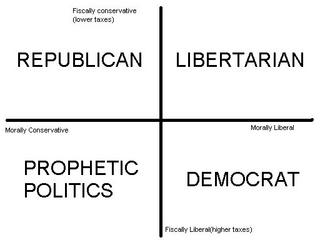
Where do I sign up? Who wouldn't want more moral restrictions combined with having less money? Well Jim says..."
Yes, it's for people that "...want to put their faith into practice," but just can't fathom how to do it without government assistance. Isn't one of the great aspects of the United States of America that I can grab a placard and preach on any corner or go load up my car with a paycheck's worth of food and clothes and hand it out to the needy as I see fit. Or maybe that I can start a church and we can pool our resources and spread God's love through tracts and canned foods and new shoes and free medicine and free daycare. No, that is not the solution. You see the proper way to fix what ails the world is to prioritize so that "...values of politics are my primary concern."
Yes, it's for "...people - religious, spiritual, or not." But how will the "nots" feel about a "...political vision that rises out of biblical passages from prophetic texts," a.k.a. the Bible? That little nugget has already been noted by Elisabeth Castelli when she wrote on Slate (the very conservative news site) in a review of God's Politics that, "Moreover, it is also in the midst of this discussion that "religion" morphs into what Wallis is really talking about: "the religion," that is, Christianity...For Wallis, religion is not one possible source among many for influential narrative of justice; the Bible is the source." She doesn’t like that, but back to me. If “A life of Christianity” replaced “Prophetic politics in this sentence: ”...Prophetic politics would not be an endless argument between personal and social responsibility, but a weaving of the two together in search of the common good," Jim and I would have very few problems, but unfortunately for him it’s politics as usual.
So, we have man of God espousing a political ideology that will limit much and hand out much. One that only one of the three current viable political parties might lend even a modicum of support. One that I feel is more anti-Christian-- or at least challenges God's priorities-- yet makes no bones about the fact that it is based on the Bible. As an aside, throughout all the articles and columns by Jim Wallis I have read (the number is getting way too big) there would seem to be an obvious lack of direct quotes or mentions of specific scripture. Aside from some mentions of prophets and some vague allusions to the Sermon on the Mount, Wallis chooses not to back up any of his claims with chapter and verse. All this leaves me with the question of, "What's he actually up to?"
Maybe I'll get to that...
In an election year, the particular religiosity of a candidate, or even how devout they might be, is less important than how their religious and/or moral commitments and values shape their political vision and their policy commitments. Understanding the moral compass they bring to their public lives and how their convictions shape their political priorities is the true litmus test.Ok, so what the minister, Jim Wallis, is saying is that it does not matter if a certain individual is a Christian, even if he is an extremely devout one. What matters are his politics. I'm sure Billy Graham made that same point very clear to every President he visited in the White House.
In the "God's Politics: A Better Option" article (linked above), we finally get some loose definition for what Jim Wallis hopes. It is what he calls "prophetic politics". He states:
"THERE ARE NOW three major political options in our public life. The first political option in America today is conservative on everything - from cultural, moral, and family concerns to economic, environmental, and foreign policy issues.
...The second political option in contemporary America is liberal on everything - both family/sexual/cultural questions and economic, environmental, and foreign policy matters.
...The third option in American politics is libertarian - meaning liberal on cultural/moral issues and conservative on fiscal/economic and foreign policy. The "just leave me alone and don’t spend my money option" is growing quickly in American life."
Those are your choices, but Big Jim has a better option...
"I believe there is a "fourth option" for American politics, which follows from the prophetic religious tradition we have described. It is "traditional" or "conservative" on issues of family values, sexual integrity and personal responsibility, while being very "progressive," "populist," or even "radical" on issues like poverty and racial justice. It affirms good stewardship of the earth and its resources, supports gender equality, and is more internationally minded than nationalist - looking first to peacemaking and conflict resolution when it come to foreign policy questions.
Ok, let's chart this out. If you have a block bisected both horizontally and vertically. It moves left to right from morally conservative to morally liberal politically. It moves top to bottom from fiscally conservative (lower taxes) to fiscally liberal (higher taxes). So in the top/left corner are Republicans. Next to them on the top are Libertarians. Below the Libertarians are the Democrats. The new option, which is morally restrictive and fiscally restrictive, is "Prophetic politics" and it fills in the bottom/left box.
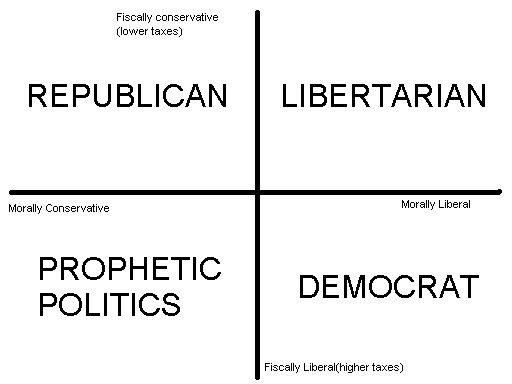
Where do I sign up? Who wouldn't want more moral restrictions combined with having less money? Well Jim says..."
...At the heart of the fourth option is the integral link between personal ethics and social justice. And it appeals to people who refuse to make the false choice between the two.
Who are these people? Many are religious: Catholics, black and Latino Christians, evangelicals who don’t identify with the Religious Right, and members of all our denominational churches who want to put their faith into practice. They are Jews and Muslims who are guided by an active faith and not just a personal background. They are people who do not consider themselves "religious," but rather "spiritual," and would be drawn to a fourth option in politics. And they are people - religious, spiritual, or not - who consider themselves shaped by a strong sense of moral values and long for a political commitment that reflects those values.
...It would speak directly to the proverb "Without a vision, the people perish," and would offer genuine political vision that rises out of biblical passages from prophetic texts. Our own ancient prophetic religious traditions could offer a way forward beyond our polarized and paralyzed national politics and be the foundation for a fourth political option to provide the new ideas politics always needs.
...Prophetic politics would not be an endless argument between personal and social responsibility, but a weaving of the two together in search of the common good."
Yes, it's for people that "...want to put their faith into practice," but just can't fathom how to do it without government assistance. Isn't one of the great aspects of the United States of America that I can grab a placard and preach on any corner or go load up my car with a paycheck's worth of food and clothes and hand it out to the needy as I see fit. Or maybe that I can start a church and we can pool our resources and spread God's love through tracts and canned foods and new shoes and free medicine and free daycare. No, that is not the solution. You see the proper way to fix what ails the world is to prioritize so that "...values of politics are my primary concern."
Yes, it's for "...people - religious, spiritual, or not." But how will the "nots" feel about a "...political vision that rises out of biblical passages from prophetic texts," a.k.a. the Bible? That little nugget has already been noted by Elisabeth Castelli when she wrote on Slate (the very conservative news site) in a review of God's Politics that, "Moreover, it is also in the midst of this discussion that "religion" morphs into what Wallis is really talking about: "the religion," that is, Christianity...For Wallis, religion is not one possible source among many for influential narrative of justice; the Bible is the source." She doesn’t like that, but back to me. If “A life of Christianity” replaced “Prophetic politics in this sentence: ”...Prophetic politics would not be an endless argument between personal and social responsibility, but a weaving of the two together in search of the common good," Jim and I would have very few problems, but unfortunately for him it’s politics as usual.
So, we have man of God espousing a political ideology that will limit much and hand out much. One that only one of the three current viable political parties might lend even a modicum of support. One that I feel is more anti-Christian-- or at least challenges God's priorities-- yet makes no bones about the fact that it is based on the Bible. As an aside, throughout all the articles and columns by Jim Wallis I have read (the number is getting way too big) there would seem to be an obvious lack of direct quotes or mentions of specific scripture. Aside from some mentions of prophets and some vague allusions to the Sermon on the Mount, Wallis chooses not to back up any of his claims with chapter and verse. All this leaves me with the question of, "What's he actually up to?"
Maybe I'll get to that...
Wednesday, March 16, 2005
Why God is a Republican
...or maybe a Libertarian.
Ah yes, the post that's been swimming around in my mind forever. The last couple of posts have tried to at least lay the foundation for what Jim Wallis believes and what he thinks the role of government should be in our lives. Worry not, I'm not finished with him, believe you me. Yesterday, I mentioned more than once that I believe Jesus and the New Testament as a whole are silent on politics and whether we are to strive for theocracies. I don't think we should, I will attempt to explain my rational.
My pastor has said on more than one occassion that we get ourselves in trouble when we ask the Bible questions it does not answer. Maybe I'm falling into the same trap, but because I feel the Bible does not explicitly say how I should vote, I am forced to come up with standards on my own. The Bible is fairly clear that God's priorities should be my priorities. Also, because politics will inevitably require you to take non-believers into account and because I feel that most of the New Testament (especially those epistles) is instruction for believers, those admonitions cannot be applied to citizens who have yet to choose to follow Christ. So, I take the two things that I believe are imperitive for anyone to find God through Christ. The two things that God grants us so as to allow us the opportunity to choose correctly. One: Life. Pretty much a given. Hard to do anything if you have yet to live. This is essentially from where my stance against abortion stems. God created you...and me (with some slight modifications). Life is the first gift He chooses to bestow on all of us, it's the universal gift. Therefore, it should be protected. The second is of almost equal importance. One that is reinforced by C.S. Lewis in Mere Chrisitanity. The one that says God has no use for automatons, robots, human puppets. Free will.
Without free will, we can never choose to follow God. Never choose to do right instead of wrong. Never choose to hand the fiver to the guy on the corner instead of the barista at Starbucks. Never choose to swallow the insult that sits at the tip of the tongue. Life is a series of choices, and with most we have the opputunity to choose to go the way of God or to stay on the path of self.
So, those things being said, if we must have a form of government, I believe God would have us choose some form of democracy. Any other type would force one to heed to the will of another without any say in the matter. It would then follow that when choosing which candidate to lend my vote, it would be the one that supports a philosophy that remove governments retraints on my liberty, including how I use my money. I therefore think that instituting high tax rates with the purpose to redistribute the wealth to those who are considered in more need can be considered a moral issue. Taking money, or property, from someone against their will and giving it to someone else is called theft, no matter how benevolent the motive might be. God wants me to use my money and energy to help those in need. I think he has a far different view if I were to sneak into a neighbor's house, and take what I found and "donate" it to the poor. I think he has a commandment that addresses that, but my Bible has come under some suspicion lately, so you might want to check it out yourself. I agree with the words of Linda Bowles when she wrote,
Some will say, well what about all that money for defence. I also believe that the purpose of government, the reason we need it in our lives at all, is to do the things which the single citizen or small community cannot. One of those things would be to ensure that China doesn't come in through the back gate and to make sure that every building over 10 stories doesn't get leveled by some cadre of fundamentalist muslims, christians, atheists, or other nuts who decide it's a symbol of evil.
We are not commanded to take money from the "tax collector" and give it to the poor before he figures out it is gone. We are not asked to steal from the "rich young ruler" because he has accumulated much and obviously won't miss it. We are implored to talk them, the sit with them, to dine with them, to walk with them, to love them. Not so we can lure them into a false sense of security so to liberate their property into the hands of those who "can really use it", but to change their hearts so they make the choices God wants. Mr. Wallis wants a government that removes the possibility of stories like that of Dr. Robert Cade, or he hope renders them moot. If the tale is true, Dr. Cade invented Gatorade in 1965 and has since reaped millions in royalties. He still lives in the same house in Gainesville, FL. He has used the proceeds for various charitble needs. When asked about it he is said to have replied, "God has blessed me in all kinds of ways--including a big income. In the book of Deuteronomy God tells the Israelites a man should give as he is blessed. I think I am duty bound to do as He suggests."
Amen.
Ah yes, the post that's been swimming around in my mind forever. The last couple of posts have tried to at least lay the foundation for what Jim Wallis believes and what he thinks the role of government should be in our lives. Worry not, I'm not finished with him, believe you me. Yesterday, I mentioned more than once that I believe Jesus and the New Testament as a whole are silent on politics and whether we are to strive for theocracies. I don't think we should, I will attempt to explain my rational.
My pastor has said on more than one occassion that we get ourselves in trouble when we ask the Bible questions it does not answer. Maybe I'm falling into the same trap, but because I feel the Bible does not explicitly say how I should vote, I am forced to come up with standards on my own. The Bible is fairly clear that God's priorities should be my priorities. Also, because politics will inevitably require you to take non-believers into account and because I feel that most of the New Testament (especially those epistles) is instruction for believers, those admonitions cannot be applied to citizens who have yet to choose to follow Christ. So, I take the two things that I believe are imperitive for anyone to find God through Christ. The two things that God grants us so as to allow us the opportunity to choose correctly. One: Life. Pretty much a given. Hard to do anything if you have yet to live. This is essentially from where my stance against abortion stems. God created you...and me (with some slight modifications). Life is the first gift He chooses to bestow on all of us, it's the universal gift. Therefore, it should be protected. The second is of almost equal importance. One that is reinforced by C.S. Lewis in Mere Chrisitanity. The one that says God has no use for automatons, robots, human puppets. Free will.
Without free will, we can never choose to follow God. Never choose to do right instead of wrong. Never choose to hand the fiver to the guy on the corner instead of the barista at Starbucks. Never choose to swallow the insult that sits at the tip of the tongue. Life is a series of choices, and with most we have the opputunity to choose to go the way of God or to stay on the path of self.
So, those things being said, if we must have a form of government, I believe God would have us choose some form of democracy. Any other type would force one to heed to the will of another without any say in the matter. It would then follow that when choosing which candidate to lend my vote, it would be the one that supports a philosophy that remove governments retraints on my liberty, including how I use my money. I therefore think that instituting high tax rates with the purpose to redistribute the wealth to those who are considered in more need can be considered a moral issue. Taking money, or property, from someone against their will and giving it to someone else is called theft, no matter how benevolent the motive might be. God wants me to use my money and energy to help those in need. I think he has a far different view if I were to sneak into a neighbor's house, and take what I found and "donate" it to the poor. I think he has a commandment that addresses that, but my Bible has come under some suspicion lately, so you might want to check it out yourself. I agree with the words of Linda Bowles when she wrote,
"At the heart of American capitalism is the principle that what a man earns by his creativity and effort, no matter how much or little, is his own. It is not the property of government, and no other citizen, no matter how needy, has a claim or a right to it. This is one of the core principles that made America the most prosperous nation the world has ever known. It is a principle based on individual sovereignty and freedom."That, in a very verbose nutshell, is it. I believe that in most cases Rebublicans currently emphasize liberty over goverment interferance. Therefore, I believe their priorties are closer to God's priorities.
Some will say, well what about all that money for defence. I also believe that the purpose of government, the reason we need it in our lives at all, is to do the things which the single citizen or small community cannot. One of those things would be to ensure that China doesn't come in through the back gate and to make sure that every building over 10 stories doesn't get leveled by some cadre of fundamentalist muslims, christians, atheists, or other nuts who decide it's a symbol of evil.
We are not commanded to take money from the "tax collector" and give it to the poor before he figures out it is gone. We are not asked to steal from the "rich young ruler" because he has accumulated much and obviously won't miss it. We are implored to talk them, the sit with them, to dine with them, to walk with them, to love them. Not so we can lure them into a false sense of security so to liberate their property into the hands of those who "can really use it", but to change their hearts so they make the choices God wants. Mr. Wallis wants a government that removes the possibility of stories like that of Dr. Robert Cade, or he hope renders them moot. If the tale is true, Dr. Cade invented Gatorade in 1965 and has since reaped millions in royalties. He still lives in the same house in Gainesville, FL. He has used the proceeds for various charitble needs. When asked about it he is said to have replied, "God has blessed me in all kinds of ways--including a big income. In the book of Deuteronomy God tells the Israelites a man should give as he is blessed. I think I am duty bound to do as He suggests."
Amen.
Tuesday, March 15, 2005
Jim Wallis Gets Neither God Nor Politics
With many of the quotes from yesterday, at their face value, I have no problem. In some cases, a closer look reveals deeper motives. One thing to remember about Jim Wallis, maybe the most important thing, it that all his beliefs refer to the political realm, not the personal. In most cases, I think the Bible is reticent, if not completely unconcerned with the political world.
Where in the Bible do we find the call to be "...committed to international cooperation rather than unilateral policies," or even that "Christ commits Christians to a strong presumption against war?" If anything, I think the New Testament states the political issues nation-states face matter very little. Does God really care if the United States government asks France and Germany if it's ok to bomb an enemy? I doubt it. It's the "personal" that is important. Of course, I think it would be hard to argue that God in the Old Testament at times didn't support war. Am I supposed to believe the nature of God completely changed? But this is not a debate for today.
Certain statements also bother me because their mere existence would seem to indicate that Mr. Wallis' political opposites agree with such stances. Why is it necessary to say, "that faith creates community from racial, class, and gender divisions and prefers international community over nationalist religion, and we see that "God bless America" is found nowhere in the Bible." Who thinks "God bless America" is in the Bible? Should they be included in a substantive debate? Who's pushing a "nationalist religion?" Does he believe "the Right" is trying to separate people into "...racial, class, and gender divisions?” I think he might. An accusation of the party he supported in the last election was that Republicans were out to squash the vote of minorities. Do such baseless accusations work to create a community that ignores race? When he says, "Some things ought never be done - torture, the deliberate bombing of civilians, the use of indiscriminate weapons of mass destruction..." does he believe our government just drops nukes on cities to see their reaction? Does he have evidence of "deliberate bombing of civilians?"
Anyway, what we find from reading a sampling of Jim Wallis' writing is that he believes that, "Budgets are moral documents. They reflect the values and priorities of a family, church, organization, city, state, or nation." Also, that, "Any serious reading of the Bible points toward poverty as a religious issue, and candidates should always be asked by Christian voters how they will treat the least of these." Things we can agree on: the Bible does make poverty a religious issue. The question is where does the Bible make poverty a political issue? The answer. It doesn't. It is silent on what the government should do. Jesus is very clear that we should take care of the poor, as is Paul. And what Wallis does is take the fact that "...any serious reading of the Bible points toward poverty as a religious issue," and comes to the conclusion that we should therefore become activists to create a welfare state to care for the poor. In the same vein, I would agree that "...Budgets are moral documents. They reflect the values and priorities of a family, church, organization." Here's where we start to differ. A city? Maybe. A state. Less likely, but ok. But a nation. Ok, I guess I would agree that it currently is. But is not the bigger question, should it be? The founders did not intend for the federal government to take stances on morality and religion. They hoped to leave those issues to the states. Wallis may state that he wants to "...avoid the dangerous accumulations of power and wealth," but how else do you care for the poor of the world, much less a nation, with out accumulating wealth...and therefore power? You can't. If your goal is to have the federal government to ensure every person is fed 3 square, has medical insurance, and can watch Oprah everyday; someone has to pay for it. Without even going into the question of where it would come from, money must be ACCUMULATED so it can then be distributed where it is 'needed'. If I could just remember where God lays out how to create the proper bureaucracy to help the needy. Is it II Corinthians? Maybe it is in the Sermon on the Mount...oh well.
I, on the other hand, believe that the responsibility to care for the poor falls to believers and the church...still trying to find where Jesus mentions the government. I will start from there in the next post, as I fear I have gone on too long, already.
Where in the Bible do we find the call to be "...committed to international cooperation rather than unilateral policies," or even that "Christ commits Christians to a strong presumption against war?" If anything, I think the New Testament states the political issues nation-states face matter very little. Does God really care if the United States government asks France and Germany if it's ok to bomb an enemy? I doubt it. It's the "personal" that is important. Of course, I think it would be hard to argue that God in the Old Testament at times didn't support war. Am I supposed to believe the nature of God completely changed? But this is not a debate for today.
Certain statements also bother me because their mere existence would seem to indicate that Mr. Wallis' political opposites agree with such stances. Why is it necessary to say, "that faith creates community from racial, class, and gender divisions and prefers international community over nationalist religion, and we see that "God bless America" is found nowhere in the Bible." Who thinks "God bless America" is in the Bible? Should they be included in a substantive debate? Who's pushing a "nationalist religion?" Does he believe "the Right" is trying to separate people into "...racial, class, and gender divisions?” I think he might. An accusation of the party he supported in the last election was that Republicans were out to squash the vote of minorities. Do such baseless accusations work to create a community that ignores race? When he says, "Some things ought never be done - torture, the deliberate bombing of civilians, the use of indiscriminate weapons of mass destruction..." does he believe our government just drops nukes on cities to see their reaction? Does he have evidence of "deliberate bombing of civilians?"
Anyway, what we find from reading a sampling of Jim Wallis' writing is that he believes that, "Budgets are moral documents. They reflect the values and priorities of a family, church, organization, city, state, or nation." Also, that, "Any serious reading of the Bible points toward poverty as a religious issue, and candidates should always be asked by Christian voters how they will treat the least of these." Things we can agree on: the Bible does make poverty a religious issue. The question is where does the Bible make poverty a political issue? The answer. It doesn't. It is silent on what the government should do. Jesus is very clear that we should take care of the poor, as is Paul. And what Wallis does is take the fact that "...any serious reading of the Bible points toward poverty as a religious issue," and comes to the conclusion that we should therefore become activists to create a welfare state to care for the poor. In the same vein, I would agree that "...Budgets are moral documents. They reflect the values and priorities of a family, church, organization." Here's where we start to differ. A city? Maybe. A state. Less likely, but ok. But a nation. Ok, I guess I would agree that it currently is. But is not the bigger question, should it be? The founders did not intend for the federal government to take stances on morality and religion. They hoped to leave those issues to the states. Wallis may state that he wants to "...avoid the dangerous accumulations of power and wealth," but how else do you care for the poor of the world, much less a nation, with out accumulating wealth...and therefore power? You can't. If your goal is to have the federal government to ensure every person is fed 3 square, has medical insurance, and can watch Oprah everyday; someone has to pay for it. Without even going into the question of where it would come from, money must be ACCUMULATED so it can then be distributed where it is 'needed'. If I could just remember where God lays out how to create the proper bureaucracy to help the needy. Is it II Corinthians? Maybe it is in the Sermon on the Mount...oh well.
I, on the other hand, believe that the responsibility to care for the poor falls to believers and the church...still trying to find where Jesus mentions the government. I will start from there in the next post, as I fear I have gone on too long, already.
Monday, March 14, 2005
Jim Wallis, Let Him be Your Prophet
Well, I have spent the last few days reading some of big Jim's articles and columns as well as interviews and articles about Mr. Wallis. One thing I can say is that he's is big on recycling. There are some sentences/paragraphs I ran into several times with seemingly a tittle unchanged. But that's really not the issue.
I will attempt to lay a brief groundwork as to what Wallis believes, or protends to believe. I just throw some quotes at you to get things rolling:
More later.
I will attempt to lay a brief groundwork as to what Wallis believes, or protends to believe. I just throw some quotes at you to get things rolling:
...That faith challenges the powers that be to do justice for the poor, instead of preaching a "prosperity gospel" and supporting politicians that further enrich the wealthy.
..."That faith hates violence and tries to reduce it, and exerts a fundamental presumption against war, instead of justifying it in God’s name."
..."That faith creates community from racial, class, and gender divisions and prefers international community over nationalist religion, and we see that "God bless America" is found nowhere in the Bible." (PREACH IT, BROTHER!)
..."The best public contribution of religion is precisely not to be ideologically predictable nor a loyal partisan." (That's the BEST? Really?)
..."The scriptures claim the poor are regularly neglected, exploited, and oppressed by wealthy elites, political rulers, and indifferent affluent populations," and "...make clear that poverty is indeed a religious issue and that the failure of political leaders to help uplift those in poverty will be judged a moral failing." (What verse is that again?)
..."It is indeed our theology of evil that makes us strong proponents of both political and economic democracy—not because people are so good, but because they often are not and need clear safeguards and strong systems of checks and balances to avoid the dangerous accumulations of power and wealth." (Let me get this straight, we DON'T trust people, so we trust democracy? A.K.A majority rule?)
..."Christ commits Christians to a strong presumption against war," and we should be "...committed to international cooperation rather than unilateral policies." (Maybe they just forgot to highlight that in red in my Bible)
..."Some things ought never be done - torture, the deliberate bombing of civilians, the use of indiscriminate weapons of mass destruction - regardless of the consequences."
..."We are to show love to our enemies even as we believe God in Christ has shown love to us and the whole world. Enemy-love does not mean capitulating to hostile agendas or domination. It does mean refusing to demonize any human being created in God's image."
More later.
Thursday, March 10, 2005
Me v. Jim Wallis
This will probably run off the only two people who occasionally read this woeful blog, but I have made a decision. Or maybe I'm heeding a call. It seems that the websites I frequent, the people I talk to, the blogs I read; all find time to sing the praises of Jim Wallis, his new book God and Politics (there's a subtitle, but I'm lazy) and generally anything put out by Sojourners (a.k.a. Jim Wallis). Many Christians, especially those 35 and under, are finding just what they are looking for in big Jim's writings. Basically, biblically justified liberalism. Now they can go to Starbucks and Half-Price books and fit in! So over the next few days...ok, probably weeks I will take time to find all the ways Jim leaves me wanting. Some of the possible titles of posts over this time could be:
So stayed tuned.
"Jim Wallis neither understands politics nor God"
"Why God is a Republican"
"Hi, I'm Jim Wallis, where's my money?"
"Robin Hood: Great folklore, bad basis for government philosophy"
"If one person giving is good, how can everyone giving be bad?"
"Exactly how many times did Jesus accuse fellow believers of treason?"
"Are the unborn and mass murderers morally equivalent?"
"Jim Wallis and Oprah. Who's more likely to be the anti-Christ?"
...and many others.
So stayed tuned.
Subscribe to:
Posts (Atom)